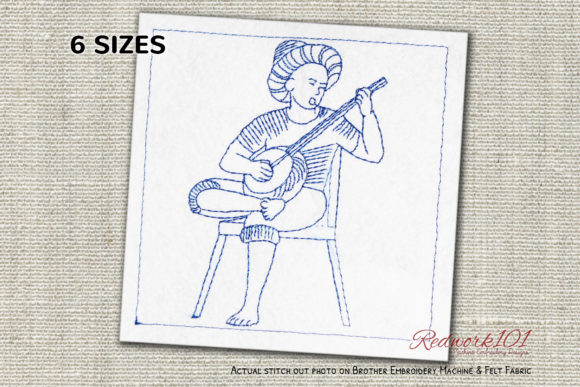
Banjo Player Redwork Design
First Impression: Rustic Charm with Instant Recognition
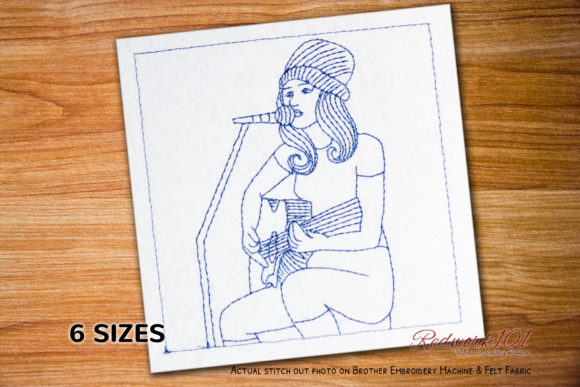
As an embroidery designer who’s curated over 200 craft fair booths, I’ll say it straight: Banjo Player Redwork Design lands with warm, approachable authenticity. It reads as rustic, folksy, and gently nostalgic—not overly cute, not aggressively modern, but unmistakably musical and handmade. The redwork style implies tradition, care, and a tactile quality that shoppers instinctively associate with premium small shop products. At a glance, it signals “music lover,” “small-town pride,” or “vintage Americana”—three powerful emotional hooks at craft fairs and handmade markets.
Where It Shines: Product-by-Product Real-World Performance
Banjo Player Redwork Design isn’t one-note—it adapts beautifully across formats, but its strengths are specific:
- Tote bags & market bags: A standout focal point when centered on the front panel. Its vertical composition fits naturally on standard 15” x 15” totes without distortion—and reads clearly even from six feet away.
- Aprons: Perfectly scaled for chest placement. The banjo’s shape echoes apron pockets and waist ties, creating visual rhythm. Customers consistently pause longer at aprons featuring music-themed embroidery like Banjo Player Redwork Design.
- Tea towel embroidery: Works best on medium-weight linen or cotton towels (not terry). Avoid dense weaves—the design’s clean lines need breath. Place it in the lower third for balance; it adds personality without overwhelming utility.
- Embroidered patches: Highly viable. The redwork aesthetic translates well to iron-on or sew-on patches, especially when backed with twill or denim. Ideal for Etsy sellers bundling “Music Lover” gift sets.
- Caps & curved surfaces: Use caution. The banjo’s rounded body and neck require careful digitizing for caps—test stitch pull on scrap fabric first. Not ideal for low-profile trucker hats unless simplified.
- Pillow covers & pouches: Excellent at smaller scales (3.5”–4.5”). Retains legibility and charm. On 8” square pillow covers, it anchors the design without competing with fabric prints.
What Makes It Sell: Attention, Value, and Booth Impact
In a crowded craft fair aisle, Banjo Player Redwork Design cuts through noise—not with loudness, but with familiarity and warmth. Shoppers recognize the instrument instantly. That split-second recognition builds trust: “This maker understands my world.” It elevates perceived value on otherwise simple items—turning a plain canvas tote into a conversation starter, or a basic tea towel into a giftable handmade product.
For boutique makers and Etsy sellers, this design supports brand consistency. Pair it with other music-themed embroidery files—guitar silhouettes, sheet music motifs, or vintage microphone icons—and you build a cohesive collection. On booth displays, it performs strongest when shown on *real* finished products (not just printed mockups), especially alongside complementary items like handmade guitar picks or lyric-printed cards.
Production Reality Check: What You Must Test Before Batch Work
Don’t skip these steps—especially if you’re preparing for a weekend craft fair:
- Test the embroidery file on scrap fabric matching your final product (e.g., duck canvas for totes, flour-sack cotton for towels).
- Verify thread contrast: Redwork relies on high-contrast stitching. On dark fabrics, switch to navy or charcoal thread—not black—to preserve detail.
- Review spacing and stitch density: The banjo’s strings and fretboard can compress at smaller sizes. If using under 3”, simplify or omit fine string lines.
- Confirm hoop size compatibility: This is likely a 4”–5” design—but always check your machine’s max hoop before digitizing adjustments.
- Choose stabilizer wisely: Tear-away works for smooth cottons; cut-away adds durability for textured towels or repeated washing.
- Create at least one real mockup—not just a printable mockup. Light, fabric drape, and thread sheen change everything in person.
- Compare fabric colors: Some red threads dull on warm-toned linens. Swatch three reds side-by-side before committing.
- Confirm commercial licensing: Since Banjo Player Redwork Design is intended for craft fair products and handmade markets, verify whether the embroidery file includes commercial use rights—or if a separate license is required for finished goods.
Careful-Use Notes for Maximum Clarity
This design has subtle traps. The optional Box Stitch (mentioned in the description) adds framing—but only if your fabric and stabilizer support clean outer edges. Skip it on thick canvas or looped terrycloth. Tiny details—like the player’s fingers or banjo tuning pegs—will vanish on textured towels or curved cap fronts. Avoid placing Banjo Player Redwork Design near seams or hems where distortion occurs. And never scale below 2.75” without reviewing every element: small lettering (if included in variants) and thin string lines lose integrity fast.
Final Verdict: A Reliable, Mood-Driven Craft Fair Asset
Banjo Player Redwork Design is more than a machine embroidery design—it’s a mood anchor. It connects with customers who value storytelling, craftsmanship, and gentle humor. It photographs cleanly for Etsy listings and social previews, supports batch production without sacrificing handmade quality, and strengthens booth cohesion when paired with complementary Music and Embroidery themes. For embroidery business owners, digital sellers, and creative entrepreneurs, it’s a low-risk, high-resonance addition to your design assets—provided you test, adapt, and present it thoughtfully. Bring it to your next craft fair on an apron or tote, and watch how often someone smiles, points, and says, “I play too.” That’s not just a sale—that’s a connection.