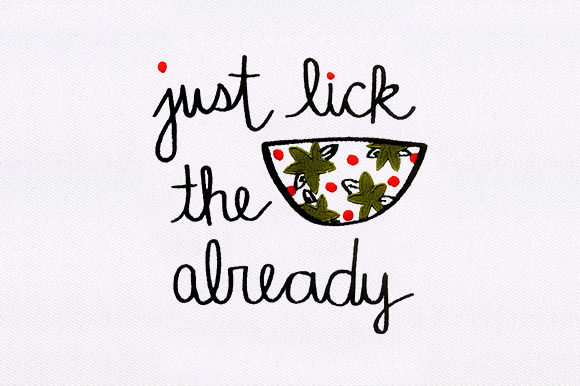
Just Lick Already
A Craft Fair Designer’s Real-World Review Before Booth Day
As an embroidery designer who’s prepped over 200 craft fair booths—from tiny pop-ups in local libraries to full weekend markets at historic barns—I’ve learned one truth: a design must earn its place on your table. Not just look good on screen, but stop people mid-stride, spark a smile, and feel unmistakably handmade. That’s why I pulled Just Lick Already off my design library last week—and ran it through the full craft fair stress test.
First Impression: Bold, Playful, and Unapologetically Kitchen-Focused
The title alone tells you everything: this isn’t a whisper—it’s a wink with confidence. Just Lick Already lands as bold, modern, and delightfully cheeky—no farmhouse frills, no vintage script, no pastel softness. It’s the kind of machine embroidery design that says “I know what I’m doing” while still inviting laughter. For kitchen-themed products, that tone is gold: it balances utility with personality, making aprons feel fun and tea towels feel like conversation starters.
Where It Shines On Craft Fair Products
- Tote bag design: Works brilliantly centered on the front panel—large enough to read from six feet away, yet tight enough to avoid overwhelming the fabric. Perfect for market bags meant to carry bread, flowers, or small-batch jam.
- Apron embroidery: Ideal above the pocket or across the bib. The phrase reads cleanly even when scaled to 4–5 inches wide—no letter crowding, no awkward spacing.
- Tea towel embroidery: A standout on linen-cotton blends. The rhythm of the phrase gives visual weight without competing with towel texture—unlike overly dense floral motifs that vanish on terry loops.
- Embroidered patch: Holds up beautifully at 2.5–3 inches. Clean outlines, minimal fill, and generous letter spacing mean it won’t blur when heat-applied or sewn onto denim jackets or canvas pouches.
- Fabric pouch & pillow cover: Scales down gracefully to 3.75 inches—still legible, still charming. Avoid going smaller than 2.25 inches unless you’re using high-contrast thread colors and ultra-smooth fabric.
- Caps & curved surfaces: Proceed with caution. The straight-line layout doesn’t wrap naturally around crown curves—best reserved for flat-front panels (like snapbacks) or embroidered patches sewn on afterward.
What Makes It Sell—And What Makes It Stick
This isn’t just another digital embroidery file. Just Lick Already has booth magnetism: it’s instantly readable, emotionally resonant (“Yes! I *do* lick the spoon!”), and photograph-ready. As an Etsy seller or small shop product, it performs well in printable mockups—clean lines render crisply in lifestyle shots, and the phrase pops against neutral backdrops like marble, wood, or creamy linen.
For batch production? It’s repeatable. Moderate stitch density means faster runs, less thread breakage, and consistent results across cotton twill, medium-weight linen, and quilting cotton. No tiny serifs, no overlapping letters, no fragile flourishes that snag during trimming. That reliability saves time—and preserves your reputation as a maker who delivers polished finished products.
Careful-Use Notes Every Embroiderer Should Know
Even strong designs have limits—and skipping these checks risks wasted fabric, frustrated customers, or booth-day panic:
- Dense stitch areas: While overall density is moderate, the inner curves of “g” and “y” can compact. Always test on your target fabric + stabilizer combo before running 20 tea towels.
- Small lettering: At under 2 inches tall, the lowercase “i” and “l” may lose distinction on textured towels or dark fabric. Boost contrast with bright white or neon thread—or skip sub-2-inch applications entirely.
- Thick or napped fabric: Avoid heavy canvas or terry cloth without tear-away + cut-away stabilizer layers. The design needs clean registration, not muffled edges.
- Dark fabric: Use matte or semi-gloss thread—not metallic—for maximum legibility. Test thread colors on scrap first; some “cream” or “ivory” threads disappear on charcoal linen.
How It Elevates Your Handmade Product & Booth Presence
Just Lick Already does more than decorate—it signals intention. Customers notice the wit, the craftsmanship, and the confidence behind it. On a crowded craft fair table, it helps your booth stand out not through volume, but voice. Paired with cohesive branding (think matching tote + apron + tea towel sets), it builds brand consistency without feeling repetitive.
It also raises perceived value. Buyers understand that clear, balanced, well-digitized embroidery takes skill—and they’re willing to pay more for that handmade quality. When displayed alongside plain items, Just Lick Already-embroidered pieces become natural anchors: “Oh, I need that apron.” “Wait—where’s that spoon joke?” “Can I get it on a pouch too?”
Designer-to-Designer Production Checklist
- Test the embroidery file on scrap fabric—same type, same color, same stabilizer you’ll use for production.
- Check thread contrast in natural light and under booth lighting (many fairs use warm LED—some pastels fade there).
- Review spacing between letters and words—especially if stitching on curved hems or angled pockets.
- Confirm hoop size compatibility with your machine. This design fits comfortably in a 5×7 hoop—but verify before hooping 30 aprons.
- Inspect stitch density visually—not just on screen. Overly tight fills trap moisture and stiffen fabric; too loose looks unfinished.
- Match stabilizer to fabric: cut-away for knits, tear-away for stable wovens, and fusible + tear-away for lightweight linens.
- Create at least one real mockup—not just digital. Drape it, hold it, fold it. Does it still read when scrunched in a tote?
- Compare fabric colors side-by-side: cream on oatmeal vs. ivory on slate behaves differently. Don’t assume.
- Confirm commercial licensing applies to your use case. This is a machine embroidery design intended for commercial embroidery—verify terms before selling finished products.
Bottom line? Just Lick Already isn’t just another kitchen embroidery file. It’s a smart, scalable, shelf-ready asset—built for makers who want their craft fair product to land with clarity, charm, and zero embroidery headaches. Run it right, and it won’t just sell—it’ll start conversations, build loyalty, and earn its spot front-and-center on your table.